
Mercury (planet) facts for kids

Mercury in true color taken by the MESSENGER spacecraft.
|
|||||||||||||
| Designations | |||||||||||||
|---|---|---|---|---|---|---|---|---|---|---|---|---|---|
| Hermes, Apollo | |||||||||||||
| Adjectives | Mercurian, Mercurial, Hermean | ||||||||||||
| Orbital characteristics | |||||||||||||
| Epoch J2000 | |||||||||||||
| Aphelion | 0.466697 AU (69.8169 million km) | ||||||||||||
| Perihelion | 0.307499 AU (46.0012 million km) | ||||||||||||
| 0.387098 AU (57.9090 million km) | |||||||||||||
| Eccentricity | 0.205630 | ||||||||||||
|
|||||||||||||
| 115.88 d | |||||||||||||
|
Average orbital speed
|
47.36 km/s | ||||||||||||
| 174.796° | |||||||||||||
| Inclination |
|
||||||||||||
| 48.331° | |||||||||||||
| 29.124° | |||||||||||||
| Satellites | None | ||||||||||||
| Physical characteristics | |||||||||||||
| Dimensions | 4,881.06±0.08 × 4,876.52±0.08 km | ||||||||||||
|
Mean diameter
|
4,878.8±0.2 km | ||||||||||||
|
Mean radius
|
|
||||||||||||
| Flattening | 0.0009 | ||||||||||||
|
|||||||||||||
| Volume |
|
||||||||||||
| Mass |
|
||||||||||||
|
Mean density
|
5.427 g/cm3 | ||||||||||||
| 3.7 m/s2 (0.38 g0) | |||||||||||||
|
Moment of inertia factor
|
0.346±0.014 | ||||||||||||
| 4.25 km/s | |||||||||||||
| 176 d | |||||||||||||
|
Sidereal rotation period
|
|
||||||||||||
|
Equatorial rotation velocity
|
3.026 m/s | ||||||||||||
| 2.04′ ± 0.08′ (0.034°) | |||||||||||||
|
North pole right ascension
|
|
||||||||||||
|
North pole declination
|
61.41° | ||||||||||||
| Albedo | |||||||||||||
| Temperature | 437 K (164 °C) | ||||||||||||
|
|||||||||||||
| −2.48 to +7.25 | |||||||||||||
| −0.4 | |||||||||||||
| 4.5–13 | |||||||||||||
| Atmosphere | |||||||||||||
|
Surface pressure
|
Less than 0.5 nPa | ||||||||||||
| Composition by volume | |||||||||||||
.svg)
Mercury is the closest planet to the Sun and the smallest planet in our Solar System. It is a rocky world that looks very similar to Earth's Moon. Its surface is covered with thousands of craters, vast dusty plains, and giant rocky cliffs. Mercury has almost no atmosphere to trap heat or protect it from space rocks.
Because Mercury orbits so close to the Sun, it experiences extreme conditions. Temperatures on the surface can rise to a scorching 430 °C (800 °F) during the daytime. At night, without an atmosphere to keep the warmth in, temperatures drop down to an icy −180 °C (−290 °F). Despite being the closest planet to the Sun, it is actually the second-hottest planet after Venus, which has thick clouds that trap heat.
Mercury speeds around the Sun faster than any other planet. It completes one full orbit in just about 88 Earth days. A single day-night cycle on Mercury takes 176 Earth days because the planet spins very slowly on its axis. Robotic space probes like Mariner 10, MESSENGER, and BepiColombo have helped scientists map its rugged landscape and study its giant iron core.
Contents
- Discovering the Swift Planet and Its Origins
- What Are the Physical Features of Mercury?
- How Extreme Are the Weather and Atmosphere?
- Does Mercury Have a Magnetic Field?
- How Does Mercury Orbit and Spin?
- How Can You Observe Mercury from Earth?
- How Have Space Probes Explored Mercury?
- Images for kids
- See also
Discovering the Swift Planet and Its Origins
How Mercury Got Its Name and Symbol
People have watched Mercury move across the night sky for thousands of years. In ancient times, people often thought it was two separate objects because it appeared near sunrise and sunset. The ancient Greeks called the morning view Apollo and the evening view Hermes. Later, Greek astronomers realized both lights were the same swift planet and kept the name Hermes, the speedy messenger of the gods.
The ancient Romans renamed the planet Mercury after their own winged messenger god. They chose this name because the planet travels across the sky much faster than any other planet. The astronomical symbol for Mercury is ☿, which represents the winged staff or caduceus carried by the messenger god.
Ancient Skywatchers and Early Observations
The earliest recorded sightings of Mercury come from ancient civilizations. Assyrian clay tablets dating back over three thousand years refer to Mercury as the "jumping planet." Babylonian astronomers recorded its movements in detail during the first millennium BC, calling it Nabu.
In ancient China, astronomers named Mercury the "Hour Star" and connected it with the element of water. Ancient Maya astronomers tracked Mercury with great care and represented it as an owl messenger. In India, classical texts called the planet Budha, associating it with wisdom and the day Wednesday.
What Are the Physical Features of Mercury?

Mercury is a terrestrial planet, which means it is made mostly of rock and metal rather than gas. It is the smallest planet in the Solar System, measuring only 4,879 km (3,032 mi) across its equator. Mercury is only slightly larger than Earth's Moon. In fact, two large moons in our Solar System—Ganymede around Jupiter and Titan around Saturn—are wider than Mercury, though Mercury is heavier because it is dense.
Mercury is the second densest planet in the Solar System, right behind Earth. Its high density comes from having a massive iron core packed inside a relatively small rocky shell. About 70% of Mercury's total weight comes from metal, while the remaining 30% consists of silicate rocks.
Inside Mercury: The Huge Iron Core and Thin Mantle

Deep inside Mercury lies a massive metallic core that makes up nearly 85% of the planet's radius. Scientists estimate that the core is about 4,040 km (2,510 mi) across. This makes the core enormous compared to the rest of the planet. By comparison, Earth's core takes up a much smaller percentage of Earth's total volume.
The core is made mostly of iron and nickel, mixed with smaller amounts of silicon, sulfur, and carbon. Scientific measurements show that the outer part of this core is liquid molten metal, while the inner core is solid. Surrounding this metallic center is a rocky mantle and a solid crust made of silicate minerals, which together measure only about 420 km (260 mi) thick.
Scientists have several ideas to explain why Mercury has such a gigantic core:
- A giant impact theory suggests a huge space rock hit young Mercury billions of years ago. The crash may have stripped away most of its original outer rocky crust and mantle.
- A solar heat theory suggests that intense heat from the young Sun vaporized the planet's outer rocky layers into gas, which were then blown away by solar winds.
- An accretion drag theory proposes that solar nebula gases created drag on lighter rocky dust particles, preventing them from gathering onto Mercury while it was forming.
Data from the MESSENGER mission showed high levels of volatile elements like potassium and sulfur on the surface. Because extreme heat would have driven these elements completely away into space, scientists think the giant impact and extreme vaporization ideas need adjusting.
The Surface Landscape: Craters, Cliffs, and Plains


Mercury's surface looks very rugged and heavily scarred by ancient space impacts. Because Mercury has no thick atmosphere, wind, or rain, its surface features do not wash or blow away over time. Most of the craters formed billions of years ago remain visible today, telling a detailed story of the Solar System's violent early history.
The craters on Mercury are named after famous artists, writers, painters, poets, and musicians from world history who made important contributions to culture. For example, you can find craters named after Leonardo da Vinci, Ludwig van Beethoven, William Shakespeare, and John Lennon.

Huge Impact Basins and Unique Craters

The largest known impact feature on Mercury is the magnificent Caloris Planitia, also called the Caloris Basin. This giant circular basin measures about 1,550 km (960 mi) across, which is roughly one-third the diameter of the entire planet. The asteroid that created Caloris was so enormous that the collision caused volcanic eruptions and created mountain rings over 2 km (1.2 mi) tall around the crater rim.
.png)

On the exact opposite side of Mercury from Caloris lies a bizarre area called the "Weird Terrain." Scientists believe that massive seismic shock waves from the Caloris impact traveled straight through the planet and met on the opposite side. The violent energy broke the crust into chaotic hills, ridges, and fractured valleys.
Another unusual crater on Mercury is named Apollodorus, nicknamed "the Spider." This crater sits in the middle of more than a hundred narrow fracture troughs that radiate outward in all directions like spider legs.

Rolling Plains and Volcanic Floods
There are two main kinds of plains on Mercury:
- Inter-crater plains: These are gently rolling, hilly areas situated between large craters. They are the oldest visible surfaces on Mercury and formed when early lava flows filled older landscapes.
- Smooth plains: These are flat, younger volcanic plains that fill large low basins and depressions. They resemble the dark volcanic plains (maria) found on our Moon.
Giant Wrinkle Ridges and Shrinking Cliffs

One of the most remarkable discoveries on Mercury is a system of massive cliffs called lobate scarps or rupes. These cliffs stretch for hundreds of kilometers and rise up to 3 km (1.9 mi) high into the sky. Famous examples include Discovery Rupes and Carnegie Rupes.
These giant cliffs formed because Mercury has been slowly cooling down over billions of years. As the vast iron core cooled, the metal contracted and Mercury began to shrink. The solid rocky crust buckled, cracked, and pushed upward along fault lines, creating steep ridges. Scientific estimates indicate that Mercury's total radius has shrunk by up to 7 km (4.3 mi) since its formation.
Ancient Volcanoes and Magma Vents

While Mercury has no active volcanoes today, it experienced significant volcanic activity in the past. Space probes have discovered explosive volcanic vents across the surface. Many of these vents sit inside impact craters and are surrounded by bright, reflective deposits of volcanic ash and minerals.
Inside the Caloris Basin, scientists spotted a large volcanic vent system made of multiple overlapping pits. These collapse pits formed when magma moved underneath the ground, causing the surface rock to sink into empty underground magma chambers.
How Extreme Are the Weather and Atmosphere?
The Super-Thin Exosphere
Mercury does not have a thick, breathable atmosphere like Earth. Instead, it possesses an extremely thin layer of gases called an exosphere. The air pressure on Mercury's surface is less than one-trillionth of Earth's atmospheric pressure, which is practically a pure vacuum.
Mercury's gravity is too weak and the solar heat is too strong to hold onto a permanent atmosphere. The atoms in the exosphere constantly escape into space and are replaced by new atoms through several natural processes:
- The solar wind constantly carries hydrogen and helium atoms from the Sun and deposits them onto the surface.
- Micrometeorites crash into surface rocks at high speeds, vaporizing minerals into glowing clouds of sodium, potassium, and calcium gas.
- Sunlight and charged particles knock atoms directly out of surface minerals in a process called sputtering.
Wild Temperature Swings
Because Mercury has virtually no atmosphere to spread warmth around the globe, it experiences the most extreme temperature swings of any planet in the Solar System:
- At the equator during daytime, the surface reaches blazing temperatures of 430 °C (806 °F). This heat is more than hot enough to melt lead.
- At night, with no air blanket to trap the warmth, the temperature drops rapidly down to −180 °C (−292.0 °F).
Hidden Water Ice at the Frozen Poles

Even though Mercury gets intensely hot during the day, it contains large deposits of frozen water ice. Mercury has almost no axial tilt, meaning its poles stand straight up relative to its orbit. As a result, the Sun always stays very low on the polar horizon.
The deep floors of impact craters at Mercury's north and south poles never receive direct sunlight. These permanently shadowed areas act as natural deep-freezers called cold traps. Temperatures inside these craters stay below −170 °C (−274 °F) permanently.
In the 1990s, powerful Earth-based radio telescopes bounced radar signals off Mercury and detected bright, reflective patches inside these polar craters. Later, instruments aboard the MESSENGER spacecraft confirmed that these frozen patches are thick sheets of water ice mixed with dark, carbon-rich organic materials. Scientists believe this ice was delivered over billions of years by comets and icy asteroids crashing into the planet.
Does Mercury Have a Magnetic Field?

Scientists were surprised when the Mariner 10 spacecraft discovered that Mercury has a global magnetic field. Even though Mercury is small and spins slowly, its magnetic field is active and stable. Mercury's magnetic shield has a strength of about 1% of Earth's magnetic field.
Mercury's magnetic field is generated by a planetary dynamo. As the planet rotates, molten iron in the outer core flows and churns, creating electrical currents that produce a magnetic field.
Mercury's magnetosphere is small, but it is strong enough to deflect the stream of charged particles flowing from the Sun. When powerful solar storms hit Mercury, magnetic field lines can twist together and snap open in events called magnetic reconnections. These create magnetic tornadoes that channel energetic solar wind particles straight down onto the rocky surface.
How Does Mercury Orbit and Spin?


Mercury travels around the Sun in an oval-shaped pathway known as an eccentric orbit. Its distance from the Sun changes dramatically throughout its year:
- At its closest point (perihelion), Mercury is only 46,000,000 km (29,000,000 mi) from the Sun.
- At its farthest point (aphelion), Mercury moves out to 70,000,000 km (43,000,000 mi) away.
Mercury travels at an average speed of about 47.4 km/s (29.5 mi/s) (over 106,000 miles per hour). This speed makes it the fastest-moving planet in the Solar System. It takes Mercury just 88 Earth days to complete one trip around the Sun.
Spin-Orbit Resonance and Strange Days

For a long time, astronomers thought Mercury was tidally locked to the Sun, always keeping the same side facing the Sun just like the Moon does with Earth. In 1965, radar measurements proved that Mercury actually rotates on its axis three times for every two orbits it completes around the Sun. This special connection is called a 3:2 spin-orbit resonance.
Because of this unique motion, daytime and nighttime on Mercury behave in strange ways:
- One complete rotation on its axis (a sidereal day) takes about 59 Earth days.
- One complete day-night cycle (from sunrise to the next sunrise) takes 176 Earth days, which equals two full Mercurian years.
If you stood on certain parts of Mercury's surface during perihelion, you would see the Sun rise, stop in the sky, reverse its direction for a short time, stop again, and then continue on its normal path toward sunset. This happens because Mercury moves forward along its orbit faster than the planet is rotating on its axis around that time.
Einstein and the Mystery of Mercury's Orbit

During the 19th century, astronomers noticed something strange about Mercury's orbit. With each orbit, the point of Mercury's closest approach to the Sun slowly shifts position in space over time. This slow movement is called perihelion precession.
Using Sir Isaac Newton's laws of gravity, astronomers calculated the gravitational pulls from all other known planets. However, Newton's formulas could not fully explain Mercury's exact path; a tiny fraction of the movement was unaccounted for. Some astronomers thought an undiscovered planet named Vulcan was hiding closer to the Sun and tugging on Mercury.
In 1915, Albert Einstein solved the mystery with his general theory of relativity. Einstein showed that massive objects like the Sun warp and curve the fabric of space and time around them. Because Mercury orbits so close to the Sun's huge mass, it travels through this curved space, which slightly alters its orbit. Einstein's new equations matched the observed movement of Mercury perfectly, providing the first great proof for general relativity.
How Can You Observe Mercury from Earth?


Because Mercury stays close to the Sun, it is never seen high in a dark midnight sky from Earth. It only appears low along the horizon during morning twilight just before sunrise, or during evening twilight just after sunset. When visible, it shines brightly and can be seen with the naked eye.
Through a backyard telescope, Mercury shows phases just like Earth's Moon and Venus. As it orbits the Sun, we see different amounts of its sunlit side:
- When Mercury is between Earth and the Sun (inferior conjunction), its dark side faces us, acting like a "new moon."
- When Mercury is on the far side of the Sun (superior conjunction), its lit side faces us, acting like a "full moon."
- It is easiest to view through telescopes during its quarter phases, when it reaches its greatest angular separation from the Sun (greatest elongation).
Transits of Mercury

Every few years, Mercury passes directly between Earth and the Sun in an astronomical event called a transit of Mercury. When this happens, Mercury can be seen through properly filtered solar telescopes as a tiny black circle slowly drifting across the bright face of the Sun.
Transits of Mercury happen about 13 to 14 times each century, always occurring in May or November. The most recent transit took place on November 11, 2019, and the next one will occur on November 13, 2032.
How Have Space Probes Explored Mercury?
Sending a robotic spacecraft to Mercury is one of the most difficult challenges in spaceflight. Because Mercury is deep inside the Sun's powerful gravitational pull, a spacecraft travelling toward Mercury gains enormous speed.
To slow down and safely enter orbit around Mercury, a probe must use huge amounts of rocket fuel or perform clever planetary flybys using the gravity of Earth, Venus, and Mercury to slow itself down.

The Mariner 10 Mission (1974–1975)

NASA's Mariner 10 was the first spacecraft to visit Mercury. It flew past the planet three times between 1974 and 1975. Mariner 10 was the first spacecraft ever to use a gravitational "slingshot" assist around another planet (Venus) to reach its target.
Mariner 10 took the first close-up photographs of Mercury, revealing its Moon-like craters and massive cliffs. It also made the surprising discovery that Mercury has an active magnetic field. Because of its orbital path, Mariner 10 saw the same sunlit side on each flyby, leaving more than half of the planet unmapped.
The MESSENGER Mission (2004–2015)

NASA launched the MESSENGER probe in August 2004 to study Mercury in greater detail. After completing several flybys of Earth, Venus, and Mercury, MESSENGER entered orbit around Mercury in March 2011, becoming the first spacecraft to orbit the planet.


MESSENGER studied Mercury for over four years and achieved major scientific milestones:
- It completely mapped 100% of Mercury's surface in high resolution.
- It confirmed the existence of abundant water ice in permanently shadowed polar craters.
- It discovered evidence of ancient volcanic vents and measured the elements in the rocky crust.
- It discovered that Mercury's core is larger than previously estimated.
In April 2015, after running out of maneuvering fuel, MESSENGER was commanded to plunge into Mercury's surface, creating a new crater on the planet it spent years studying.
The BepiColombo Mission
BepiColombo is an international joint space mission created by the European Space Agency (ESA) and the Japan Aerospace Exploration Agency (JAXA). Launched in October 2018, the spacecraft carried two orbiters:
- The Mercury Planetary Orbiter (MPO), designed to photograph the surface, map mineral compositions, and measure topography.
- The Mercury Magnetospheric Orbiter (MMO or Mio), designed to study the magnetic field, exosphere, and charged solar particles.
The spacecraft completed a series of six flybys of Mercury to adjust its speed and successfully arrived in orbit around the planet in 2026. Its instruments are gathering advanced measurements of Mercury's interior, surface geology, and magnetic field.
Images for kids
-
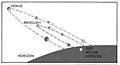
Diagram showing the greatest elongation angle between the Sun and Mercury as viewed from Earth.
-
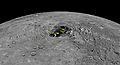
Map showing radar-bright water ice deposits (marked in yellow) inside permanently dark polar craters.
-
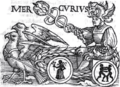
Historical drawing of the planet Mercury from the 1550 astronomical book Liber astronomiae.
-
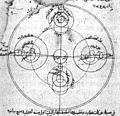
Historical 14th-century planetary diagram of Mercury's orbit by astronomer Ibn al-Shatir.
-
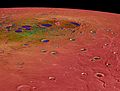
False-color temperature map of the north polar region showing extremely cold crater floors.


See also
 In Spanish: Mercurio (planeta) para niños
- Astronomy on Mercury
- Colonization of Mercury
- Chthonian planet
- Mercury in astrology
- Mercury in fiction
- Outline of Mercury (planet)
